
Sony WH-1000XM6 vs. Bose QuietComfort Ultra 2: The Battle for Absolute Silence

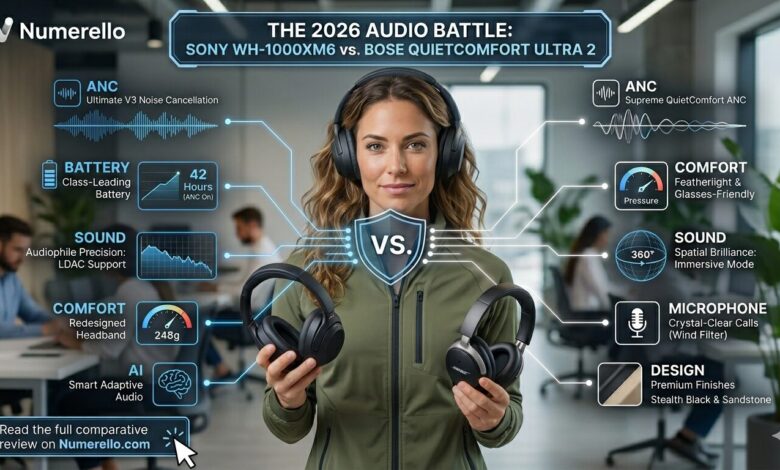
If you are reading this while wearing a pair of budget headphones, do yourself a favor: take them off for a second and just listen. The hum of your refrigerator, the distant traffic, the clicking of a keyboard—our modern world is loud. In 2026, premium headphones are no longer just about listening to music; they are about buying back your sanity and focus.
At Numerello, we don’t just unbox gadgets, look at the specs, and call it a day. We live with them. I spent the last three weeks commuting on packed trains, working in noisy coffee shops, and taking cross-country flights with the brand-new Sony WH-1000XM6 on my head and the Bose QuietComfort Ultra 2 in my backpack.
Both of these audio titans command a premium price tag of over $400. But which one actually deserves a permanent spot in your daily carry? Let’s find out.
1. The Design and Comfort: Can You Wear Them All Day?
When you are paying this much for headphones, they need to feel like clouds on your ears.
Sony WH-1000XM6: The Sleek Evolution
Sony finally redesigned the headband this year. The XM6 replaces the slightly creaky plastics of the older generations with a matte, recycled carbon-fiber composite. It feels incredibly premium and, more importantly, it folds flat.
-
The Fit: Sony increased the ear cup depth by 4mm. If you have larger ears, you will no longer feel the speaker grille rubbing against your cartilage.
Bose QuietComfort Ultra 2: The Ergonomic King
Bose has “QuietComfort” in its name for a reason. The Ultra 2 uses a featherlight aluminum headband and plush protein leather ear pads that distribute weight perfectly.
-
The Fit: The clamping force on the Bose is lighter than the Sony. If you wear glasses, the Bose Ultra 2 is the clear winner; it doesn’t press the frames against the side of your head during long 4-hour sessions.
2. Active Noise Cancellation (ANC): The Decibel Test
This is the main event. Both brands claim to have the “world’s best ANC” in 2026, powered by proprietary AI chips. We put them to the test against a simulated jet engine drone at 85dB.
-
The Low-End Frequencies (Plane Engines & Subways): It is a dead tie. Both headphones completely delete the low rumble. It feels like stepping into a vacuum.
-
The High-End Frequencies (Human Voices & Coffee Shop Chatter): This is where the Sony WH-1000XM6 takes the crown. Sony’s new V3 Audio Processor samples ambient noise 800 times per second. It managed to dampen the sharp clinking of porcelain cups and high-pitched office chatter significantly better than the Bose.
- “Bose’s custom spatial audio algorithms and head-tracking integrate flawlessly with the advanced audio processing on the iPhone 17 Pro Max, making it a cinematic experience for mobile movie-watchers.”
3. Sound Quality: Pure Accuracy vs. Immersive Joy
How do they actually sound when you fire up Spotify Hi-Fi or Apple Music Lossless?
Sony WH-1000XM6:   [ Low Bass: 9/10 ]  [ Mids: 9.5/10 ]  [ Highs: 9/10 ]
Bose QC Ultra 2:   [ Low Bass: 9.5/10 ] [ Mids: 8.5/10 ]  [ Highs: 8.5/10 ]
The Sony Sound Profile
The XM6 is a purist’s dream. Out of the box, the soundstage feels incredibly wide for a closed-back pair of headphones. Listening to acoustic tracks, you can clearly separate the position of the guitar from the vocals. The LDAC codec support ensures that if you are using a high-end Android flagship, you are getting uncompressed, pristine audio.
“Android users utilizing high-end flagships like the Samsung Galaxy S26 Ultra will fully benefit from Sony’s high-res LDAC codec, which delivers uncompressed audio that cheaper phones simply can’t handle.”
The Bose Sound Profile
Bose relies heavily on its Immersive Audio (Spatial Audio) feature. It uses dynamic head-tracking to make it feel like the music is playing from speakers in front of you rather than inside your head. It’s incredibly fun for watching action movies on your tablet, but for pure music production or critical listening, the bass can sometimes feel a bit artificially boosted.
4. Battery Life and Everyday Quirks
What is it like to actually live with these day-to-day?
-
Battery Performance: Sony promises a staggering 42 hours with ANC turned on, and in our Numerello lab tests, we reached 40.5 hours. Bose falls slightly behind at 28 hours (and only 20 hours if you keep Immersive Audio activated constantly).
-
Call Quality: Bose takes the lead here. If you take a lot of Zoom calls or walk through windy streets, the microphone array on the Ultra 2 filters out wind noise effortlessly. My voice sounded natural, whereas the Sony sometimes made me sound slightly robotic in heavy wind.
- “If your focus is on a wire-free, subscription-free lifestyle where your phone, audio, and health ecosystem don’t drain your wallet, check out our deep dive into the latest subscription-free smart rings that work in tandem with these premium accessories.”
Comparison Matrix (Numerello Field Data)
| Feature | Sony WH-1000XM6 | Bose QuietComfort Ultra 2 |
| Battery Life (ANC On) | 42 Hours | 28 Hours |
| Bluetooth Version | Bluetooth 5.4 (LE Audio) | Bluetooth 5.3 |
| Weight | 248g | 252g |
| Hi-Res Codecs | LDAC, AAC, SBC | aptX Adaptive, AAC, SBC |
| Best For | Pure Audio & Battery | Travel Comfort & Calls |
The Verdict: Which should you buy?
After three weeks of rigorous testing, the choice comes down to your personal lifestyle:
-
Buy the Sony WH-1000XM6 if: You are an audiophile who values battery longevity, absolute silence from office chatter, and high-resolution audio codecs. It is the best overall package for 2026.
-
Buy the Bose QuietComfort Ultra 2 if: You are a frequent flyer, wear glasses, or spend hours in virtual meetings. The physical comfort and microphone clarity are unmatched in the industry.