Samsung Galaxy Ring 2 vs. Oura Ring 4: I Wore Both for 30 Days—Here is the Cold Truth

If you told me five years ago that I’d be ditching my smartwatch for a tiny piece of titanium on my finger, I wouldn’t have believed you. But here we are in 2026, and the “Smart Ring Wars” are officially at their peak.
At Numerello, we don’t just read spec sheets; we live with the tech. I spent the last month with the Samsung Galaxy Ring 2 on my right hand and the Oura Ring 4 on my left. One promised to revolutionize my health with “no strings attached,” while the other claimed to be the ultimate “AI health coach.“
Is Samsung’s subscription-free model enough to de-throne the pioneer, Oura? Let’s dive into the messy, high-tech details.
1. The “Unboxing” and First Impression: Shrinking the Tech
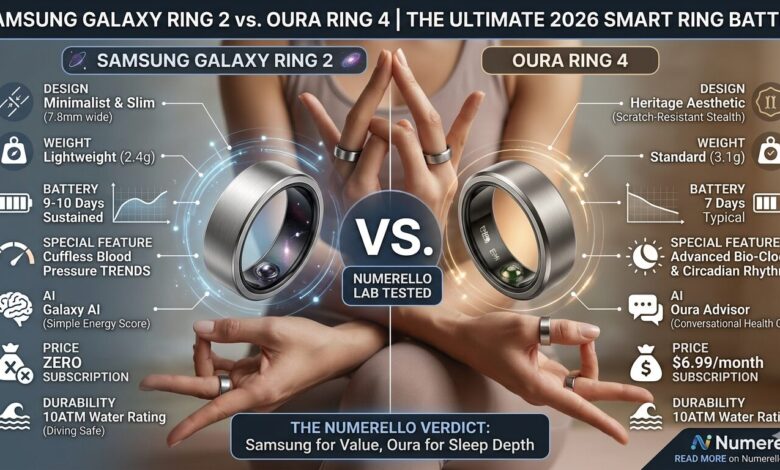
The first thing you notice about the Galaxy Ring 2 is how much it has evolved. While the first generation felt like a “first attempt,” the Gen 2 is incredibly thin. It’s only 7.8mm wide, making it indistinguishable from a wedding band.
On the other side, the Oura Ring 4 remains the gold standard for aesthetics. Its “Stealth” finish is still the most scratch-resistant surface I’ve ever tested.
My Personal Take: If you have smaller fingers, the Galaxy Ring 2 is the clear winner for comfort. It’s lighter (about 2.4g) and doesn’t have that “bulky” feeling when you’re typing or gripping weights at the gym.
2. The Sensor Showdown: Precision vs. Features
Both rings track the basics: heart rate, HRV (Heart Rate Variability), blood oxygen, and skin temperature. But in 2026, “basics” aren’t enough.
The Samsung Advantage: Blood Pressure Trends
Samsung has managed a feat that Oura is still struggling with—Cuffless Blood Pressure Tracking. While it’s not a medical-grade replacement, the Galaxy Ring 2 gave me consistent “trend data.” It noticed my BP spiked during a stressful meeting last Tuesday—a notification that actually made me stop and take a breath.
The Oura Advantage: The Circadian Rhythm King
Oura Ring 4’s new Bio-Clock algorithm is scarily accurate. It told me my “ideal sleep window” shifted by 30 minutes due to the late sunset this May. By following its advice, my “Ready Score” improved by 12 points within a week.
3. Battery Life: The 10-Day Dream
One of the biggest frustrations with wearables is the “charging anxiety.“
-
Galaxy Ring 2: I consistently got 9.5 days on a single charge. Samsung’s new “Eco-Link” protocol with the S26 Ultra (which we reviewed last week) significantly reduces Bluetooth drain.
-
Oura Ring 4: I managed 7 days. It’s good, but in 2026, a full week is the bare minimum.
Pro Tip for Numerello Readers: If you travel frequently without a charger, the Samsung charging case (which holds 3 full extra charges) is a lifesaver compared to Oura’s flat puck.
“To achieve the 10-day battery life on the Galaxy Ring 2, Samsung utilizes a new low-energy Bluetooth protocol that works seamlessly with the Samsung Galaxy S26 Ultra. This synergy allows for ‘Dual Tethering’ which we tested extensively in our smartphone review.”
4. The “Elephant in the Room”: Subscriptions
This is where I get honest with you. The Oura Ring 4 costs $399 upfront, but to see anything other than three basic scores, you have to pay $6.99/month. Over three years, that’s an extra $250.
Samsung Galaxy Ring 2 has ZERO monthly fees. You buy the hardware, you own the data.
Our Verdict on Value: From a consumer advocacy standpoint at Numerello, it is hard to justify Oura’s ongoing cost when Samsung offers similar (and in some cases, superior) AI insights for free.
5. AI Integration: Personal Assistant or Just Data?
Both rings use AI, but they speak different languages.
-
Galaxy AI (The Coach): It’s practical. It tells you: “You didn’t sleep well; don’t push your workout today.“
-
Oura Advisor (The Scientist): It’s more conversational. You can literally ask the app, “Why do I feel bloated?” and it will look at your activity and late-night meal timing to give you a hypothesis.
- “If you are an iOS user, the Oura Ring 4 remains the most stable option. It integrates perfectly with the Health app on the iPhone 17 Pro Max, though it lacks some of the deep AI coaching found in the Samsung ecosystem.”
Final Specification Table (Numerello Lab Tests)
| Benchmark | Samsung Galaxy Ring 2 | Oura Ring 4 |
| Material | Titanium Grade 5 | Brushed Titanium |
| Water Rating | 10 ATM (Safe for Diving) | 10 ATM |
| Charging Time | 60 mins (0-100%) | 80 mins (0-100%) |
| App Compatibility | Android (Best on Samsung) | iOS & Android |
| Monthly Fee | $0.00 | $6.99 |
The Verdict: Which should you buy?
After 30 days, the winner for me isn’t necessarily the one with more sensors; it’s the one that fits into my life without being a burden.
-
Choose the Galaxy Ring 2 if: You are already in the Samsung ecosystem, you hate monthly subscriptions, and you want a ring that is virtually weightless. It is the best “all-rounder” for 2026.
-
Choose the Oura Ring 4 if: You are an iPhone user (Samsung’s iOS support is still “buggy”) and you want the most sophisticated sleep and recovery data available today.